
- Who We Are
- Issues
-
Health and Hygiene
Daily life threatens health
-
Medical Care
Lives of young children that could be saved are lost
-
Nutrition
Unable to properly intake nutrition, the source of health
-
Agriculture
Unable to secure essential food for survival
-
Education
Education disparity is widening even in developing countries.
-
Industrial Development
There are people and regions that cannot escape from weak positions
-
- What We Do
- Get Involved
-
Volunteering
Want to utilize my time and skills
-
- Latest News

-
First Time Here?
Quick Guide to FIDR
- About Us
- Our Foundation
- Publications
-
Issues We Face
- Health and Hygiene
- Medical Care
- Nutrition
- Agriculture
- Education
- Industrial Development
-
What We Do
- International Cooperation for Social Development
- Emergency Response and Rehabilitation Assistance
- Public Relations and Education
-
How You Can Help
- Volunteer



How Training Transformed a Farmer's Life in Kampong Leng
Kampong Chhnang is a province located along the Tonle Sap River in Cambodia. In Kampong Leng District within the province, more than 45% of the population are farmers primarily earn their living from rice farming, according to a report from the Kampong Leng administration.
Although many families rely on rice farming for income, farmers often struggle to earn enough to support their households. High costs for seeds, fertilizers, and pesticides, along with limited farming knowledge, have continuously limited productivity and led to low rice yields.
To address these challenges, the Kampong Leng Livelihood Improvement Project (KLIP) has
been offering practical, field-based technical supports to farmers across the district. Working
closely with experts from the Provincial Department of Agriculture, Forestry and Fisheries
(PDAFF) of Kampong Chhnang, the project provides practical training on land preparation,
selecting quality seeds, proper use of fertilizers and pesticides, weed and pest control, and early
detection and treatment of rice diseases.

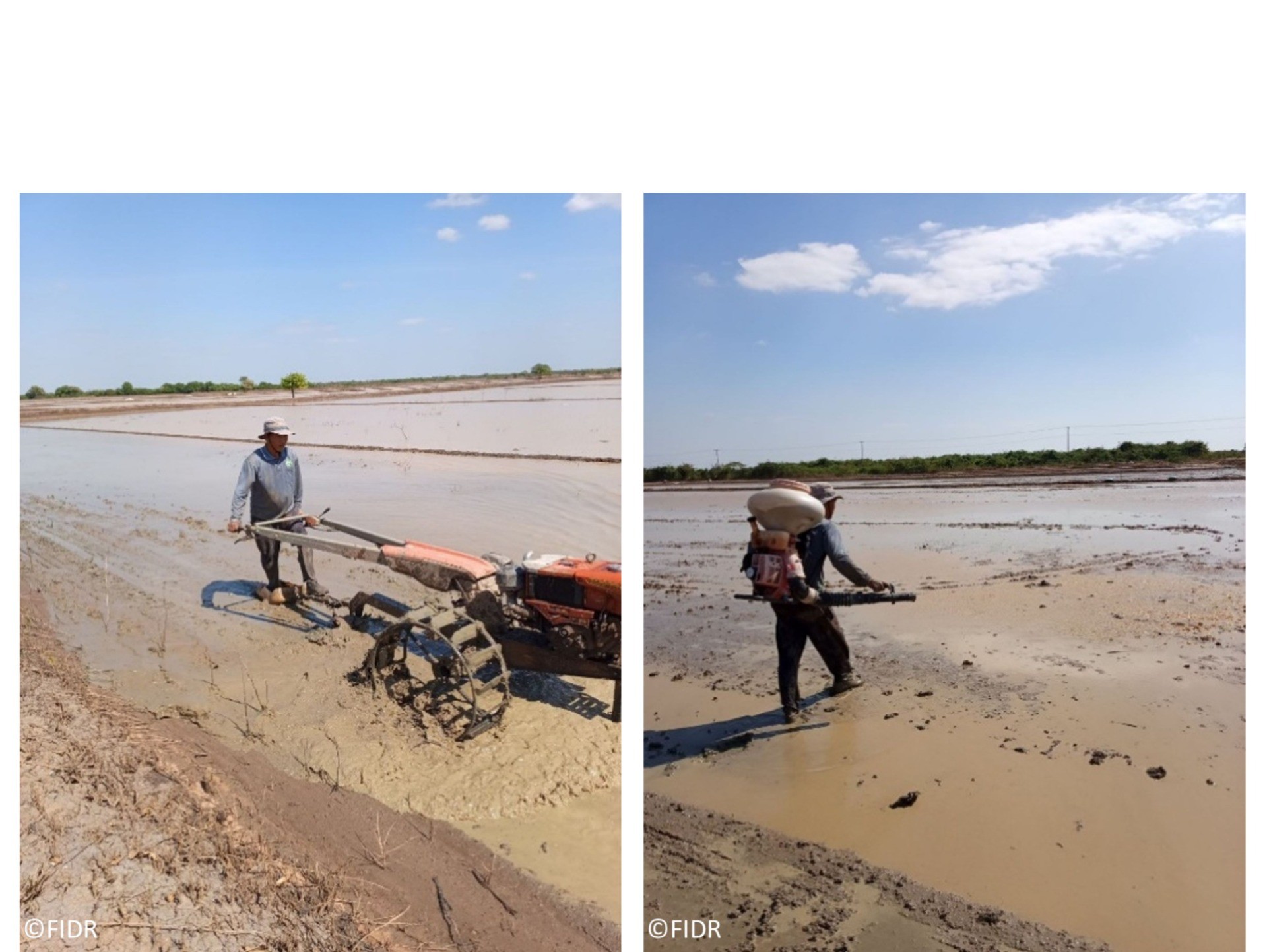
The training provides practical knowledge on land preparation and rice sowing
Ms. Ol Chamreoun, a farmer in Samrong Sen village, Samrong Sen commune, in Kampong Leng district, participated in the training and confidently shared how her rice fields have transformed. It was a change that she hadn’t expected at first.
For years, Chamreoun farmed 12 hectares of land. But her harvests were always below expectations, and her family's income from rice farming remained low. She practiced traditional farming methods passed down from her parents and lacked modern knowledge, about identifying crop diseases, controlling pests, and applying fertilizers and pesticides correctly.
"I just didn't realize that I was doing things wrong," she recalls. "I worked so hard every season, but the results never improved."
When KLIP began working in her commune, Chamreoun eagerly joined every training session, listened carefully, and asked many questions. Shifting from lifelong traditional practices to new technical methods was challenging, but she was deeply determined to transform her situation.
“I decided to try the new techniques from the training because I was losing a lot of money due to high production costs and unpredictable results,” she shared. “I wanted a farming method that cost less, earned more, and gave more reliable outcomes.”
With this change, she began applying what she learned across two hectares of her land in 2024.
Her yield increased from 9,000 kg to 13,000 kg, a 44% increase in the same land, while her seed rice usage dropped from 700 kg to just 250–300 kg. Her spending on fertilizers and pesticides also dropped significantly, and the quality of her crop improved each season. These results demonstrate that she achieved higher harvests and better quality with fewer inputs.

Rice yields increased significantly Selecting rice seeds
"Since I started using what I learned from the training, my rice crops have improved significantly, my costs have gone down, and my family's income has risen," she says with a smile.
Encouraged by these results, she decided to implement the techniques across all 12 hectares in the following season. More importantly, she did not keep this knowledge to herself. She has been sharing her success with other farmers in her village, stepping beyond her role as a project participant to become a trusted key personin her community.
"If everyone farms correctly, all of our lives can get better," she says simply.
Ms. Chamreoun's story is a great example for other farmers in Kampong Leng District who have taken part in the KLIP training. It is natural to hesitate when trying something new, but starting on a small scale, as she did, helps people witness the results directly. It builds the confidence and motivation to expand their efforts further.
FIDR believes that transformation is achieved not only through training, but also through sharing successful experiences within the community. FIDR will continue to support farmers so they can recognize their progress step by step and inspire both themselves and others through their connections.
Other Activity Reports
-
Nutrition Education and Promotion Project
2026.11.12
How Training Transformed a Far...
Cambodia Nutrition International Cooperation for Social Development -
Nutrition Education and Promotion Project
2026.06.17
Cooking Classes Begin at the M...
Cambodia Health anbd Hygiene Nutrition Education International Cooperation for Social Development
DONATION
Your generous donation now will have impacts
on children and communities in our fields.