
- Who We Are
- Issues
-
Health and Hygiene
Daily life threatens health
-
Medical Care
Lives of young children that could be saved are lost
-
Nutrition
Unable to properly intake nutrition, the source of health
-
Agriculture
Unable to secure essential food for survival
-
Education
Education disparity is widening even in developing countries.
-
Industrial Development
There are people and regions that cannot escape from weak positions
-
- What We Do
- Get Involved
-
Volunteering
Want to utilize my time and skills
-
- Latest News

-
First Time Here?
Quick Guide to FIDR
- About Us
- Our Foundation
- Publications
-
Issues We Face
- Health and Hygiene
- Medical Care
- Nutrition
- Agriculture
- Education
- Industrial Development
-
What We Do
- International Cooperation for Social Development
- Emergency Response and Rehabilitation Assistance
- Public Relations and Education
-
How You Can Help
- Volunteer



Cooking Classes Begin at the Model Schools
Through our Nutrition Education and Promotion Project in Cambodia, four model schools in Kampong Cham Province have started implementing weekly health education classes, gradually introducing nutrition topics into the curriculum.
To help students put what they have learned into practice, the schools have now launched cooking classes. These hands-on sessions provide opportunities for students to prepare healthy meals while learning basic cooking techniques and the safe use of cooking utensils and equipment. In addition to cooking skills, students also develop important life skills such as leadership, teamwork, communication, and good hygiene practices.
A New Challenge for Teachers
In Cambodia, subjects similar to home economics in Japan are included within social studies. However, practical cooking classes are rarely conducted because most schools lack appropriate facilities and equipment. Although textbooks include recipes, lessons are generally limited to reading the recipes aloud and discussing the dishes in the classroom.
To make these lessons more meaningful and reinforce the health and nutrition knowledge taught in the health curriculum, we decided to support the introduction of hands-on cooking classes at the model schools. We believe that practical experience helps students better understand and retain what they learn while equipping them with valuable cooking skills.
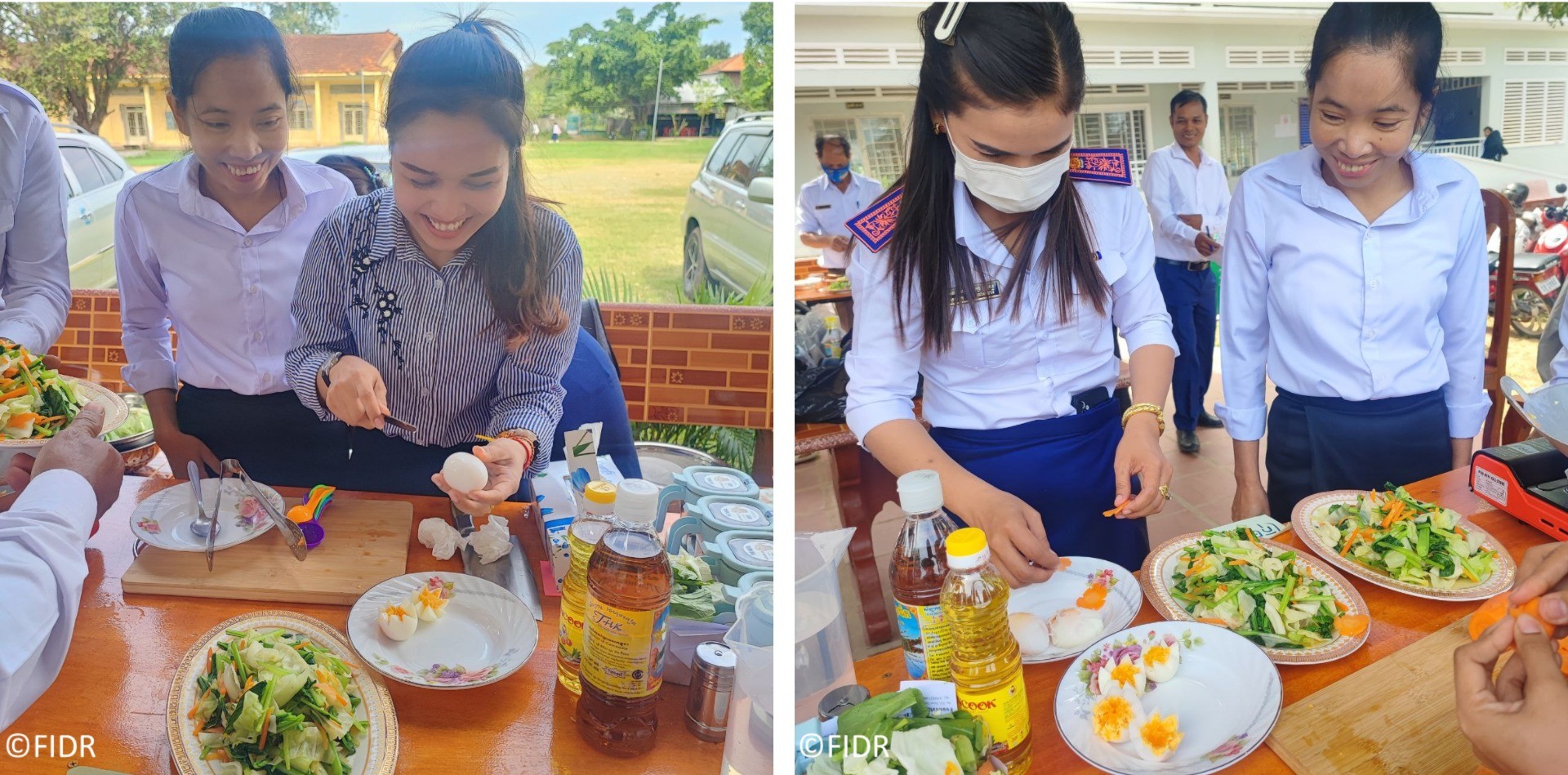
For the teachers, however, cooking classes were a completely new experience. Most had never participated in practical cooking classes during their own school years. Therefore, before introducing the classes to students, we organized a teacher training session that included a demonstration in November last year. Although some teachers cook at home, others have little cooking experience. Just as the students would later do, the teachers worked together in groups to prepare a dish. This approach allowed everyone to contribute to different tasks while improving teamwork and communication. The teachers enjoyed working together and actively participated in the training.
We also introduced fundamental cooking techniques, including the correct use of measuring tools and basic food preparation methods. For many teachers, even measuring seasonings accurately was a completely new experience, as they had never used measuring spoons or cups before. The training gave them a clear idea of what the cooking classes would be like and increased their confidence in leading the lessons.

Teachers enjoying participating in a cooking workshop.
Students' First Cooking Class
In December, the teachers conducted their first cooking classes with students. During the initial session, students prepared hard-boiled eggs and stir-fried vegetables. Since the teachers had practiced the recipes on their own after the training, the lessons were carried out smoothly.
Students also learned how to use measuring tools and cooking timers, equipment that was unfamiliar to many of them. They eagerly took part in the cooking process and were excited to discover new skills.
The children thoroughly enjoyed the experience. Many students said, "I really enjoyed cooking with my classmates!" and "The vegetables are sweet even without adding sugar!" Their reactions showed that the cooking classes provided not only practical skills but also new perspectives on healthy eating.

Strong Support from Japan
The introduction of the cooking classes was made possible through the generous support of NIPPN CORPORATION, one of our corporate supporters, which donated cooking equipment and materials to the model schools.

A commemorative photo taken in front of the cooking equipment purchased with the company’s donation
In March, representatives from the company visited the schools to observe the cooking classes. At Lavea Te Primary School, one of the four model schools, they gave a special cooking demonstration featuring Spaghetti Aglio Olio e Peperoncino. As one of the leading producers of pasta products in Japan, NIPPN introduced one of its signature recipes.
Although spaghetti is becoming increasingly popular in Cambodia, many students and teachers had never tasted this particular dish. They were impressed by both its taste and its simplicity, with many asking for second and even third servings. Because the recipe uses familiar ingredients such as garlic, chili, and olive oil, many students said they wanted to make it at home with their families.
Seeing the students concentrate on their cooking and then enjoy the meal with smiles, the NIPPN representatives commented, "We are delighted to see that our company's donation is being put to good use."

Cooking demonstration by NIPPN representatives
Looking Ahead
Cooking classes are more than just an enjoyable activity. They provide children with practical skills that support healthy and independent living. By combining classroom learning with hands-on experience, students gain the knowledge and confidence to prepare healthy meals for themselves and their families.
We hope these cooking classes will inspire students to develop lifelong healthy eating habits and encourage them to apply what they have learned both at school and at home.
For further information, please visit our Facebook post to watch the video about how we started our cooking classes. (https://www.facebook.com/share/v/1LHNh41Mxz/?mibextid=WC7FNe)
Other Activity Reports
-
Nutrition Education and Promotion Project
2026.06.17
Cooking Classes Begin at the M...
Cambodia Health anbd Hygiene Nutrition Education International Cooperation for Social Development -
Emergency Relief for Displaced People in Cambodia
2026.06.10
Emergency Assistance: Providin...
Cambodia Emergency Response and Rehabilitation Assistance
DONATION
Your generous donation now will have impacts
on children and communities in our fields.